
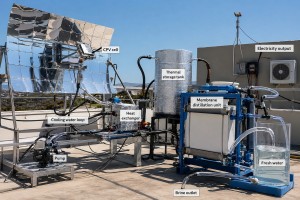
Integrated Concentrated Photovoltaic and Membrane Distillation (CPV–MD) System:
The rapid growth in global population, industrialization, and urban development has significantly increased the demand for both energy and freshwater resources. At the same time, concerns regarding climate change, environmental degradation, and the depletion of conventional energy sources have accelerated the search for sustainable technologies. Solar energy has emerged as one of the most promising renewable energy sources due to its abundance, accessibility, and environmental benefits. However, many regions that receive high solar irradiation often face severe freshwater shortages, creating a need for integrated systems capable of addressing both energy and water challenges simultaneously.
The Integrated Concentrated Photovoltaic and Membrane Distillation (CPV–MD) System is an innovative technology that combines solar electricity generation with water desalination in a single platform. The system utilizes photovoltaic panels to convert solar radiation into electrical energy while simultaneously capturing and reusing the thermal energy generated during the photovoltaic conversion process. In conventional photovoltaic systems, a considerable amount of absorbed solar energy is transformed into heat, which increases the operating temperature of the solar cells and reduces their electrical efficiency. This waste heat is typically lost to the surrounding environment, resulting in lower overall system performance.
To overcome this limitation, the CPV–MD system integrates a membrane distillation unit beneath the photovoltaic panel. Membrane distillation is a thermally driven separation process that uses a hydrophobic membrane to separate water vapor from saline or contaminated water. When heated, water evaporates on one side of the membrane and passes through the membrane pores as vapor. The vapor then condenses on the cooler side, producing clean and purified water while leaving salts, minerals, and other contaminants behind. Since membrane distillation can operate effectively using low-grade thermal energy, it is particularly suitable for utilizing the waste heat generated by photovoltaic systems.
The integration of these two technologies creates a synergistic relationship. The membrane distillation unit benefits from the thermal energy supplied by the photovoltaic panel, while the circulating feed water helps cool the photovoltaic cells, improving their electrical performance. This dual-function operation enhances the overall efficiency of the system by maximizing the utilization of incoming solar energy. Instead of producing only electricity, the integrated system generates both electrical power and freshwater, increasing the overall value and productivity of the solar installation.
The system illustrated in this project consists of multiple layers, including evaporation layers, recycle layers, porous hydrophobic membranes, condensation layers, thermal conduction layers, and thermal isolation layers. Source water flows through the system and absorbs heat from the photovoltaic module. As the water temperature rises, evaporation occurs within the membrane distillation unit. Water vapor migrates through the membrane and condenses to form freshwater, which is collected separately. The remaining concentrated brine is discharged from the system. This arrangement enables continuous operation while maintaining effective heat recovery and water purification.
One of the major advantages of the CPV–MD system is its ability to provide a sustainable solution for remote and arid regions where access to both electricity and freshwater is limited. Since the system relies primarily on solar energy, it reduces dependence on fossil fuels and minimizes greenhouse gas emissions. Furthermore, the integration of desalination and power generation into a single compact unit reduces infrastructure requirements and improves resource utilization.
The primary objective of this project is to study the design, operation, and performance of the Integrated Concentrated Photovoltaic and Membrane Distillation System. The project aims to evaluate how waste heat recovery can improve photovoltaic efficiency while simultaneously producing freshwater through membrane distillation. By investigating the system's thermal and water flow characteristics, the project seeks to demonstrate the potential of CPV–MD technology as an efficient, environmentally friendly, and economically viable solution for future energy and water sustainability challenges.